🇿🇼 Zimbabwe
Historical Photographs
Real photographs from the archives — not reconstructions. Each image is public domain and credited to its collection. Grainy, damaged and imperfect: that is what history looks like.
Images sourced from Wikimedia Commons (public domain or CC0). Attribution and licence shown with each photograph.
Quick Facts
Before Colonial Rule
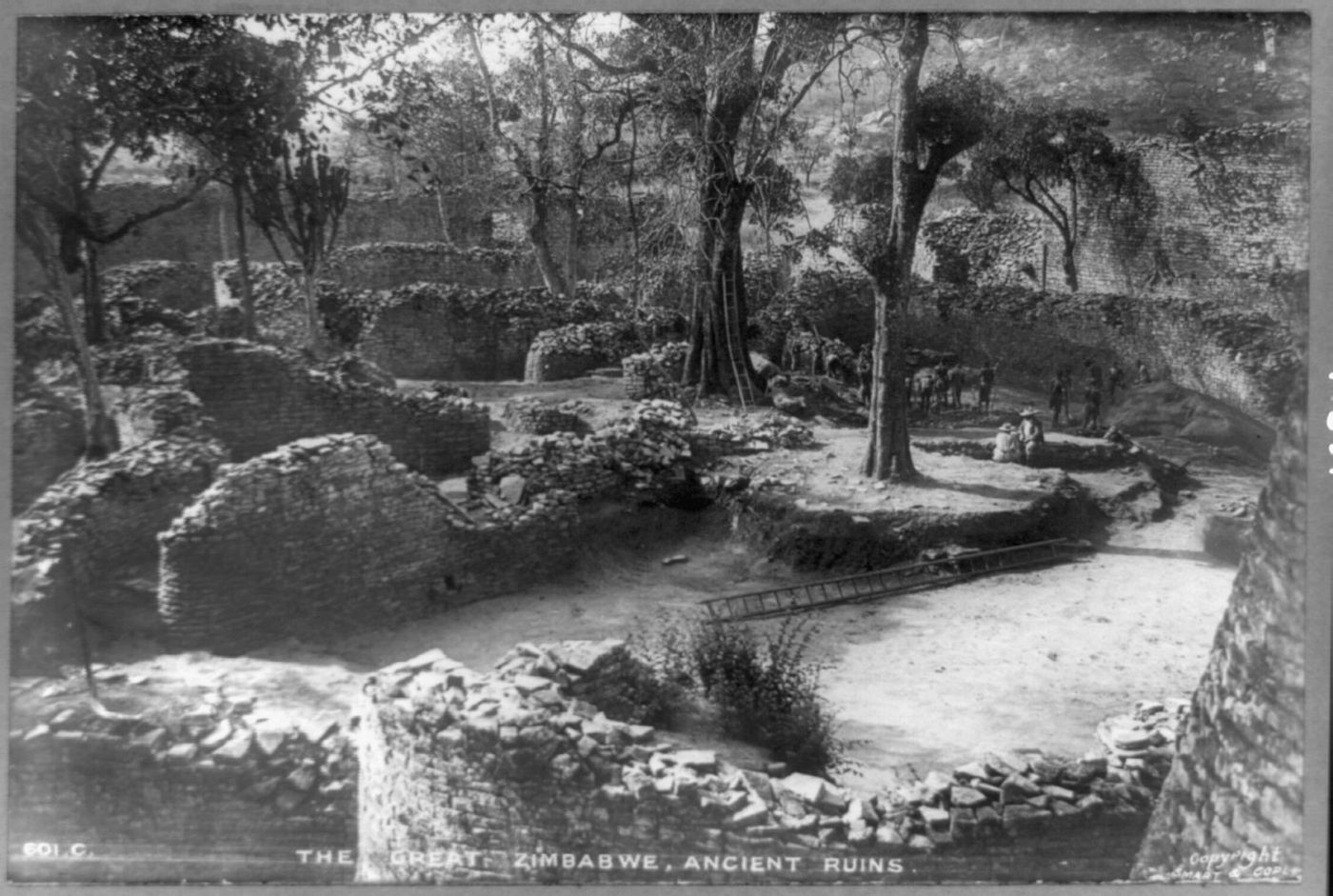
Great Zimbabwe
Between roughly 1100 and 1450, Great Zimbabwe was a powerful trading city of granite walls built without mortar — the largest ancient stone structure in sub-Saharan Africa. It traded gold and ivory with the Indian Ocean world; Chinese celadon and Persian ceramics have been excavated there.
Mutapa and Rozvi
After Great Zimbabwe’s decline the Mutapa kingdom controlled the gold trade with the Portuguese at the coast; the Rozvi state succeeded it in the Changamire period.
The colonial myth
European writers claimed Great Zimbabwe must have been built by Phoenicians or Arabs. Archaeology proved it was built by the ancestors of the Shona — a correction at the heart of Zimbabwe’s national identity.
The Colonial Period
Rhodes and the BSAC
Cecil Rhodes’s British South Africa Company occupied Mashonaland in 1890 and Matabeleland after the 1893 war; the First Chimurenga (1896–97) was its major African uprising.
Southern Rhodesia
From 1923 the territory was self-governing under white minority rule; African land ownership was restricted to a fraction of the country.
UDI and the liberation war
In 1965 Ian Smith declared unilateral independence to preserve white rule. The Second Chimurenga (1960s–1979) — ZANLA and ZIPRA guerrilla armies — ended with the Lancaster House agreement in 1979.
Independence & The Modern Nation
Independence, 18 April 1980
Zimbabwe became independent with Robert Mugabe as Prime Minister and Canaan Banana as ceremonial President.
The Gukurahundi
In the 1980s a military campaign against Ndebele civilians in Matabeleland killed thousands — a period Zimbabweans still press to have acknowledged ⚖️.
Economic collapse
In the 2000s land redistribution, political violence and hyperinflation destroyed the economy; inflation peaked in 2008 and currency reform followed.
2017 and after
In November 2017 the military intervened and Mugabe resigned after 37 years. Emmerson Mnangagwa became president and won elections in 2018 and 2023, widely criticised as not free or fair ⚖️.
Today
Zimbabwe faces debt distress, currency instability (the ZiG) and electricity shortages, while its diaspora sustains families through remittances.
Leaders & Heads of State
Every head of state since Zimbabwe became independent — how each came to power and how each left. Dates are standard reference dates; where historians or records disagree, we say so.
| Leader | In office | How they came to power | How they left |
|---|---|---|---|
| Robert Mugabe | 1980–2017 | Prime Minister 1980–87; Executive President from 1987; re-elected repeatedly | Resigned in November 2017 after military intervention |
| Canaan Banana | 1980–1987 | Ceremonial President | Retired; later convicted of abuse of office |
| Emmerson Mnangagwa | 2017–present | Succeeded Mugabe; elected 2018; re-elected 2023 | In office |
Modern & Present
Economy
Zimbabwe runs a multi-currency system (US dollar and the Zimbabwe Gold, ZiG). Mining — gold, platinum group metals, lithium — is the leading earner.
Society
One of Africa’s most educated populations; the diaspora, particularly in South Africa and the UK, is central to the economy.
Culture
Mbira music, Thomas Mapfumo’s chimurenga sound, the stone sculpture movement, and literature by Dambudzo Marechera and Tsitsi Dangarembga.
Go To The Archives Yourself
We show our sources — and these are the real archives where you can check us, free. Every archive below holds original photographs, documents and records.
People & Culture
Peoples
Shona majority (Zezuru, Karanga, Manyika, Korekore, Ndau) and Ndebele, with Kalanga, Tonga, Venda, Chewa, Shangaan minorities.
Faith
Christian majority with strong traditional belief systems; the Mwari cult and regional spirit mediums helped inspire the liberation war.
Food
Sadza (pap) with nyama or muriwo, mopane worms, bota and mahewu.